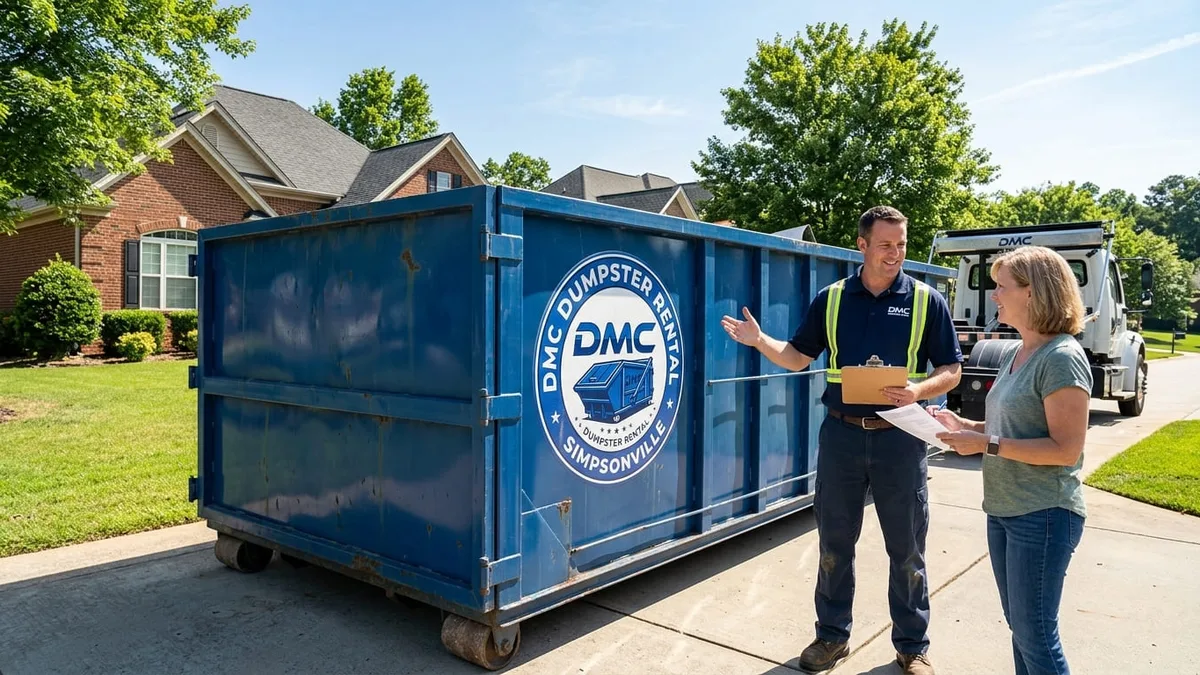
“What size do I actually need?” is the question we field more than any other, and it’s a good one to ask before you book rather than after a container shows up too small — or bigger than the job called for. Most projects around Simpsonville and the Golden Strip sort themselves into one of five sizes pretty predictably once you know the dimensions and, just as important, the weight allowances. Here’s the full lineup, along with the local factors worth keeping in mind.
10-Yard Dumpster: Small and Focused
Our smallest container is built for a job that’s genuinely contained — a single room, a garage purge, a small repair, or one load of dense material like a walkway’s worth of concrete or dirt. It’s also the size that fits most easily on a tight in-town Simpsonville lot, where older driveways near the downtown clock tower weren’t built with a full-size roll-off in mind. See the 10-yard dumpster page for full specs.
15-Yard Dumpster: A Step Up Without a Big Jump
The 15-yard sits between our smallest and mid-size containers, and it’s a good fit when a project is more than a single room but doesn’t need the full capacity of a 20-yard — a bathroom gut combined with a garage clean-out, a deck removal, or a modest roofing job on a smaller structure. If you’re weighing this one against the size above or below it, our team can help settle it on a quick call. Details on the 15-yard dumpster page.
20-Yard Dumpster: The Size Most Simpsonville Homes End Up Booking
At 22 ft long by 7.5 ft wide by 4.5 ft tall, the 20-yard dumpster holds about 6 pickup-truck loads and carries a 3–4 ton weight allowance. It’s our most-booked residential size, and for good reason — it covers a whole-house cleanout, a larger remodel spanning a few rooms, a roofing tear-off up to about 50 squares, or a full landscaping overhaul without needing a second delivery mid-project. If you call us undecided and your project sounds “medium to large but still one house,” this is very often where we land.
30-Yard Dumpster: Whole-House and Commercial-Scale Work
Step up to the 30-yard dumpster — 22 ft long by 7.5 ft wide by 6 ft tall, roughly 9 pickup-truck loads, 4–5 ton weight allowance — when the project outgrows a single household’s worth of debris. That covers whole-house renovations, commercial cleanouts, and new-build construction sites where framing offcuts and packaging pile up fast. Contractors managing a project over several weeks often prefer this size specifically so they’re not coordinating a mid-job container swap.
40-Yard Dumpster: Major Demolition and Large Sites
Our largest container, the 40-yard dumpster, measures 22 ft long by 7.5 ft wide by 8 ft tall and holds about 12 pickup-truck loads with a 5–6 ton weight allowance. It’s the size for major demolition, large-scale construction sites, and commercial fit-outs generating a steady volume of lighter debris — drywall, lumber, packaging. It’s rarely the right call for dense material on its own, since concrete, brick, or masonry debris will hit the weight allowance long before it fills a box this size — which brings us to the part of sizing people underestimate the most.
The Weight Lesson: Dense Material Fills the Weight Limit First
Every container comes with a weight allowance as well as a volume, and it’s entirely possible to fill a box only partway and still hit that ceiling. Concrete, brick, tile, dirt, and roofing shingles are the usual culprits — a load of broken concrete that barely covers the floor of a 20-yard can weigh as much as the same container packed full of old furniture and boxes. This is why “just get the bigger one” isn’t always the safer move: a larger container buys you more room, not a proportionally larger weight allowance, and dense debris doesn’t care how much empty space is left above it. If your project involves concrete, brick, or other heavy material, our concrete & heavy debris page covers how we size those loads on their own terms. And once size and weight are both sorted, our guide to what actually drives dumpster rental cost covers the rest of the picture.
Sizing for the Golden Strip: Weather and Lot Size
Two things worth factoring in locally. First, spring — roughly March through June — is severe weather season across the Upstate, with real thunderstorm and tornado risk rather than the coastal hurricane threat other parts of the state deal with. Greenville County has recorded 35 documented tornadoes since 1952, and the F1 that tracked from Simpsonville to Fountain Inn on November 11, 2002 is the one longtime residents still mention. When storms roll through and bring down limbs, fencing, and roofing material, demand for mid-size containers — the 15 and 20-yard especially — tends to spike, so booking a little ahead of a forecasted stretch of storms isn’t a bad idea. Second, lot size varies a good deal across our service area: tighter in-town Simpsonville driveways call for careful sizing, while properties farther out toward Laurens, Anderson, and Spartanburg County generally have more room to work with. Mention your driveway width and any access constraints when you call so we can confirm the size you want will actually fit.
Still Not Sure? Call and Describe the Job
If you’ve read through all five sizes and you’re still torn, that’s normal — and it’s exactly what a two-minute phone call solves. Tell us what’s coming out, roughly how much of it there is, and whether it leans bulky-and-light or dense-and-heavy, and we’ll recommend a size on the spot. It beats guessing cubic yards off a chart, and you’ll get a flat-rate quote for the size that actually fits, the first time. Call DMC Dumpster Rental Simpsonville at (864) 432-6521, whether your project is a residential dumpster rental or a larger commercial dumpster rental. Or browse the full lineup on our dumpster sizes page.