Severe Weather Season and Dumpster Rental Timing in the Upstate
Spring in the Upstate brings real severe thunderstorm and tornado risk, not just a few loud afternoons — and it changes how we schedule deliveries and pickups across the Golden Strip.
Simpsonville dumpster guide
Shingles are deceptively heavy for how little space they take up, which means a roofing tear-off is one job where weight, not volume, usually decides the size you need. Here’s how to get it right the first time.
Ask a roofer what’s different about ordering a dumpster for a tear-off versus a remodel, and the answer comes down to one word: density. A truckload of old cabinetry and drywall looks like a lot but weighs comparatively little. A truckload of asphalt shingles looks almost identical from the curb and can weigh two or three times as much. Sizing a container for a roofing job means thinking about tonnage first and cubic yards second — the reverse of how most people approach a container. Below is how we walk Simpsonville homeowners and roofing crews through that math before a container ever leaves our lot at 201 Greer Dr.
It’s a conversation worth having before the crew shows up rather than mid-tear-off, because a container that turns out to be undersized doesn’t just mean an inconvenient second pickup — it can mean a stalled job while everyone waits on a swap, or an overloaded container that a hauling truck legally can’t take on the road. Getting the size right up front keeps a one-day tear-off a one-day job.
A “square” in roofing terms is 100 square feet of roof surface, and it’s the unit that actually matters for sizing — not the size of the house. A single-layer tear-off on a roof up to roughly 50 squares generally fits a 20-yard dumpster, which is the size we deliver most often for exactly this kind of job. Push past that — a bigger roof, a steeper pitch that sheds more waste material, or a second layer of shingles coming off underneath the first — and the math shifts toward a 30-yard dumpster instead, since a double tear-off can roughly double the weight without doubling the visible pile. If you don’t know your exact square count, a rough measurement of the roof footprint plus pitch is usually enough for us to steer you to the right size over the phone.
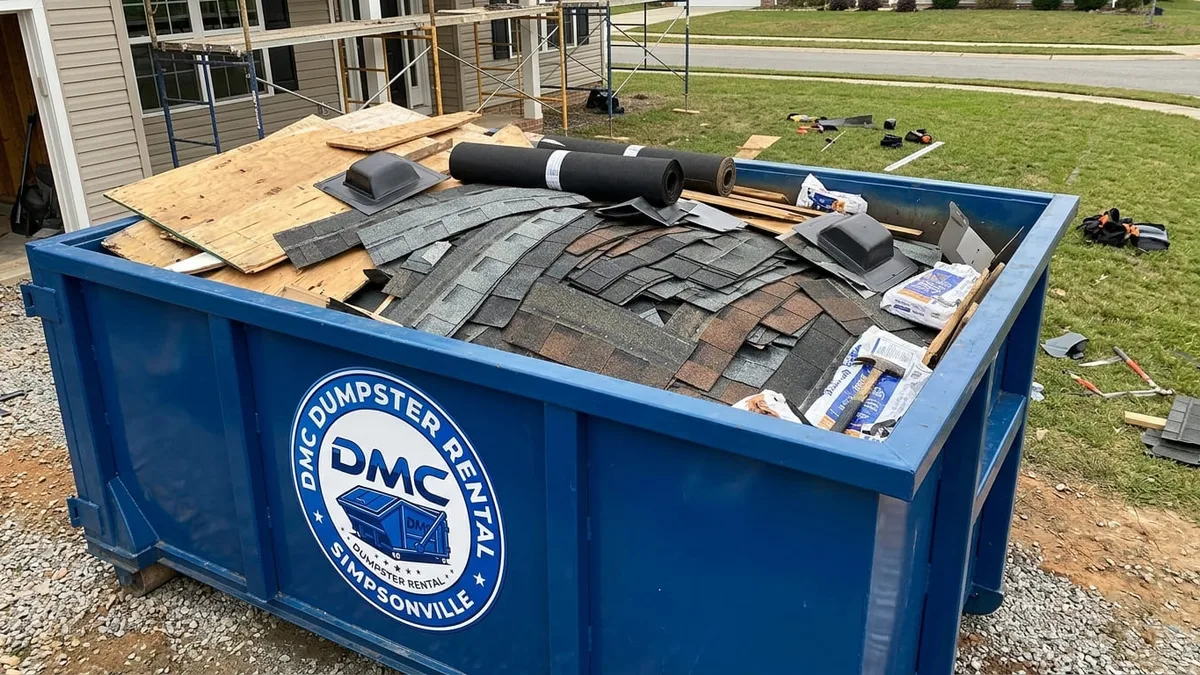
This is the part that catches first-time renters off guard: a roofing dumpster can hit its weight allowance while the container still looks half-empty. Shingles, felt paper, and the nails and flashing that come off with them are dense material stacked in a relatively small footprint, so the visual fullness of the box tells you almost nothing about how close you are to the limit. That’s why we ask about square footage and layer count up front rather than just asking “how big is your roof” — a smaller roof with two layers of old shingles can out-weigh a larger single-layer tear-off. If your project also involves other heavy material — old plywood decking, ridge tile, or ice-and-water shield — mention that too, since it stacks onto the same weight allowance. Our roofing dumpster rental page covers this in more detail alongside our general size guide, which is a useful comparison if part of your project is a roof and part is something lighter, like a gutted bathroom.
Roofing demand in the Golden Strip isn’t evenly spread across the year — it spikes hard from roughly March through June, when the Upstate’s severe thunderstorm and tornado season is at its most active. Hail and straight-line wind during that stretch are the most common reasons a roof goes from “fine” to “needs a full tear-off” almost overnight, and Greenville County has a real track record backing that up: National Weather Service Greenville-Spartanburg records show 35 documented tornadoes in the county since 1952. The one longtime residents still bring up is a specific, dated event — an F1 tornado that tracked from Simpsonville to Fountain Inn on November 11, 2002, doing exactly the kind of structural damage that turns into roofing calls for weeks afterward. If a storm just came through and you’re facing a full tear-off rather than a patch job, our severe weather scheduling guide covers how we handle the surge in demand that follows.
Timing matters more on a roofing job than on most other projects, since the container usually needs to be in place and ready before the first bundle of shingles comes off, and it needs to stay accessible for the whole tear-off rather than sitting somewhere the crew has to carry debris around to reach. We generally recommend delivery the afternoon or evening before the crew starts, so it’s positioned and out of the way of ladders, trucks, and staging material on day one. If your roofing contractor has a preferred spot for the container — close to the drop zone but clear of the work area — pass that along when you book and we’ll place it accordingly rather than guessing from the street.
Roofing debris comes off the house fast once a crew starts, which makes container placement worth thinking through before delivery day rather than during it. Most roofing dumpsters sit on the driveway directly below or near the work area, which needs no permit anywhere in our service area as long as the container stays entirely on private property. If the driveway is blocked by a work vehicle or there’s genuinely no room on the lot, street placement inside Simpsonville city limits requires a Street Cut Permit from the City’s Public Works Department, a flat $500 fee — other towns in our service area, and unincorporated parts of Greenville, Anderson, and Spartanburg Counties, each handle it differently. Our permit guide breaks that down by jurisdiction if you’re not sure which office applies to your address.
Along with the shingles themselves, a tear-off usually generates felt paper or synthetic underlayment, ridge caps, flashing, nails, and sometimes rotted decking that gets replaced along the way — all of it fair game for the roofing dumpster. What doesn’t belong is anything separately banned from landfill disposal under South Carolina law, which occasionally comes up on older properties: old gutters or downspouts are fine, but a water heater or HVAC unit pulled during the same project counts as a “white good” banned under S.C. Code § 44-96-200 and needs separate handling. If your roofing job is bundled with a bigger property cleanup, our disposal guide covers the full list of banned items so nothing holds up your pickup.
Older Simpsonville homes, especially near the historic downtown core, sometimes have two or even three layers of shingles stacked from past reroofs that skipped a full tear-off. Each additional layer adds real weight without changing the footprint of the roof, which is exactly the scenario where a homeowner’s first size guess — based on square footage alone — comes in too small. If you know or suspect your roof has more than one layer, say so when you call. It’s a five-second detail that changes the recommendation more than almost anything else in the conversation, and it’s far easier to size correctly up front than to discover the extra weight once a crew is halfway through tear-off.
The fastest way to avoid a mid-job upgrade is to call before the tear-off starts and give us three numbers: square footage of the roof, number of shingle layers coming off, and whether decking replacement is part of the scope. From there we’ll recommend a size and a flat rate up front, and if the job turns out bigger once the crew is into it, we’d rather swap you to a larger container than have you overload a smaller one past its weight allowance. Call DMC Dumpster Rental Simpsonville at (864) 432-6521 to talk through your roofing project, or browse the full lineup on our dumpster sizes page.
FAQs
A single-layer tear-off on a roof up to roughly 50 squares generally fits a 20-yard dumpster. Larger roofs or a second layer of shingles coming off underneath usually call for a 30-yard dumpster instead, since weight adds up faster than the pile looks.
Shingles, felt paper, and flashing are dense material packed into a small footprint, so a roofing container can hit its weight allowance while there’s still visible room in the box. That’s why square footage and layer count matter more than a general size guess.
Yes — a double tear-off can roughly double the weight of the debris without doubling how full the container looks, so mention layer count when you call and we’ll size accordingly, often stepping up from a 20-yard to a 30-yard.
The Upstate’s severe thunderstorm and tornado season runs roughly March through June, and hail or straight-line wind during that stretch is the most common reason a roof needs a full tear-off. Greenville County has recorded 35 documented tornadoes since 1952, including an F1 that tracked from Simpsonville to Fountain Inn on November 11, 2002.
No — placement entirely on private property, including most driveways under a roofing job site, needs no permit anywhere in our service area. Street placement inside Simpsonville requires a $500 Street Cut Permit from the City’s Public Works Department.
No — major appliances are banned from landfill disposal in South Carolina under S.C. Code § 44-96-200 as “white goods” and need separate disposal, even if they came off the same job site as the roofing debris.
Ready when you are
Call and you will speak to someone local who knows the streets, the permit rules and which box actually fits your lot. Flat rate quoted up front.
Keep reading
Spring in the Upstate brings real severe thunderstorm and tornado risk, not just a few loud afternoons — and it changes how we schedule deliveries and pickups across the Golden Strip.
Simpsonville’s downtown grew up around a blacksmith’s shop, not a subdivision plan, and that history shows up in the driveways and lot lines we work around every week. Here’s how in-town placement differs from the newer parts of the Golden Strip.
A roll-off dumpster handles most of what comes out of a cleanout or remodel, but a handful of items are legally banned from landfill disposal in South Carolina and need to go somewhere else first.